Owen Michaels doesn’t exist
The Last Thing He Told Me“Owen Michaels doesn’t exist” is Jake Bradley Anderson’s deliberately stark formulation of a discovery that does not erase Hannah’s husband so much as dismantle the biography attached to his name. An investigator can find records for people called Owen Michaels, but none who fits the life Hannah has been told about. The distinction between a name that exists on paper and a person whose recorded history matches his family’s knowledge turns the phrase into the hinge of a larger crisis: Hannah must reconsider what she knows about her husband and decide how to explain that uncertainty to Bailey.
The phrase and its correction
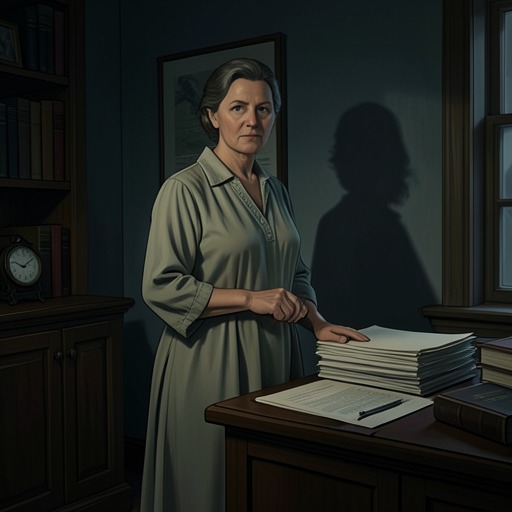
Jake first tells Hannah, “Owen Michaels doesn’t exist,” and she nearly laughs because the claim sounds ridiculous and plainly wrong to her. Bailey is asleep just fifteen feet away; her existence, and Hannah’s immediate experience of her family, seem to contradict the sentence. Jake revises his wording rather than withdrawing the discovery: “your Owen Michaels doesn’t exist.” That qualification matters. He is not claiming that no one has ever borne the name, but that no recorded Owen Michaels fits the husband Hannah believes she knows.
The investigator’s findings make the distinction concrete. The records include several people named Owen Michaels who grew up in Newton, Massachusetts, and others who attended Princeton University. But the only recorded person who both grew up in Owen’s supposed hometown and attended Princeton is seventy-eight years old and lives with his partner, Theo Silverstein, in Provincetown on Cape Cod. The overlap of familiar details is therefore not enough to establish the identity Hannah expected; when combined, the details point to someone else entirely.
Jake’s qualification also preserves an unsettling ambiguity. The investigator has found a birth certificate and Social Security number that match Owen and Bailey, but the other details of their story do not align with the record. The phrase names that gap between documentary existence and biographical consistency. It does not tell Hannah which parts of Owen’s life are true, or what name he used before Sausalito. It tells her that the account she relied on cannot be verified as the history of the person who lived it with her.
The record begins in Sausalito
The absent years provide a sharper test than the conflicting older records. Jake says the investigator has found no record of Owen purchasing or owning a home in Seattle in 2006, enrolling Bailey in preschool there that year, or filing a registered income-tax return at any time before 2009. Hannah recognizes the year in the missing history: it was when Owen and Bailey moved to Sausalito. Jake confirms that this is where the record for the man Hannah knows begins.
From that point onward, much of the account Hannah gave Jake matches the available information: the home, Bailey’s schooling, and Owen’s work. That partial correspondence makes the break more disturbing, not less. There is a traceable family life in Sausalito, but no supporting data for the earlier biography that supposedly led to it. In Jake’s account, even the family’s residence offers a clue to how limited that trail is: Owen bought a floating home rather than a conventional house. He did not own the land beneath it, and Jake describes the arrangement as more like a rental and harder to trace.
The investigation leaves two possibilities open. Owen may have used another name before arriving in Sausalito, or he may have used the name Owen Michaels while lying about the rest of his life. Jake does not identify which explanation is true. What he states is that before Sausalito he has found not one piece of data supporting the story Owen told Hannah. The phrase thus reaches beyond a questionable hometown or school record: it makes the whole pre-Sausalito biography an evidentiary blank.
Hannah’s encounter with the revelation
The discovery lands as a physical shock. Hannah sits on the hotel hallway carpet with her back against the wall, struggling to breathe as the words repeat in her mind. When Jake asks whether he should continue listing the discrepancies, she declines. The records are not abstract information to her: each one threatens the story through which she recognizes her husband and understands their shared life.
The shock deepens when Jake asks whether, two days earlier, she thought Owen capable of inventing his entire life history. Hannah stares at the carpet’s fuchsia roses, trying to find something like solace in their pattern. The ugly, specific setting holds the moment close to her immediate perception: she is not calmly assembling an explanation, but trying to make an impossible claim fit with the person she believes she knows. The investigator’s findings have changed the question from whether Owen can be located to whether Hannah ever knew the person who is missing.
Her internal conflict is framed as a collision between two stories. In the one she knows by heart, the revelations make no sense; in the story taking shape around the investigator’s findings, her husband is running from a former self whose real name she does not know. The phrase matters because it forces Hannah to hold these versions against one another without yet resolving them. The documents unsettle the biography, while memory and intimate experience continue to insist on the reality of the man she married.
Bailey and the burden of telling
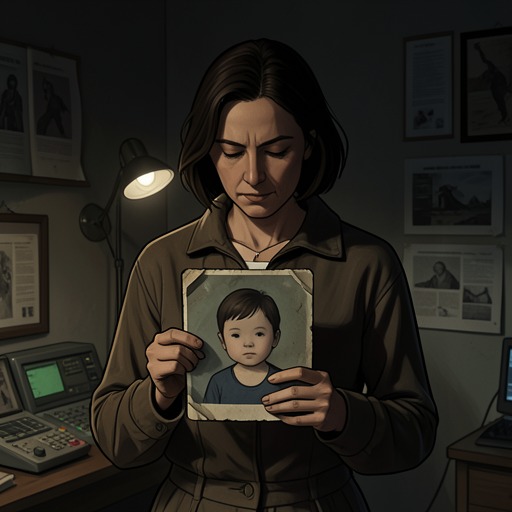
Hannah’s first practical concern is not how to explain the records to herself, but how to go back inside and tell Bailey that nothing about her father is what Bailey thinks. That statement expresses the scale of Hannah’s alarm, not a settled conclusion that every detail of Owen’s life is false. Jake has identified the unsupported period before Sausalito and the inconsistencies in the records; he has not supplied Owen’s former name or a complete account of his past. Hannah nevertheless understands that the revelation will reach Bailey through their relationship to Owen, not as a detached investigation.
Jake becomes uncharacteristically quiet before suggesting that Hannah tell Bailey something else. His answer offers no missing biography and does not undo the evidence. It shifts the immediate problem from proving who Owen was to choosing what can be said to his daughter at that moment. The expression therefore marks both an identity crisis and a break in the transmission of family knowledge: Hannah has inherited a story from Owen, discovered that its foundations are uncertain, and must decide how to speak to Bailey while that uncertainty remains.
The phrase’s force comes from its apparent finality and its actual limits. Jake says that Hannah’s Owen does not exist in the records as the person his biography describes; he does not establish that Owen himself is unreal. Sausalito, the floating home, Bailey’s schooling, and Owen’s work still leave a documentary trace. But the life before that point has no supporting data in the investigator’s search, and the man’s earlier identity remains unknown. What had seemed to Hannah like a stable name and history becomes a boundary between what her family lived and what the available evidence can confirm.